
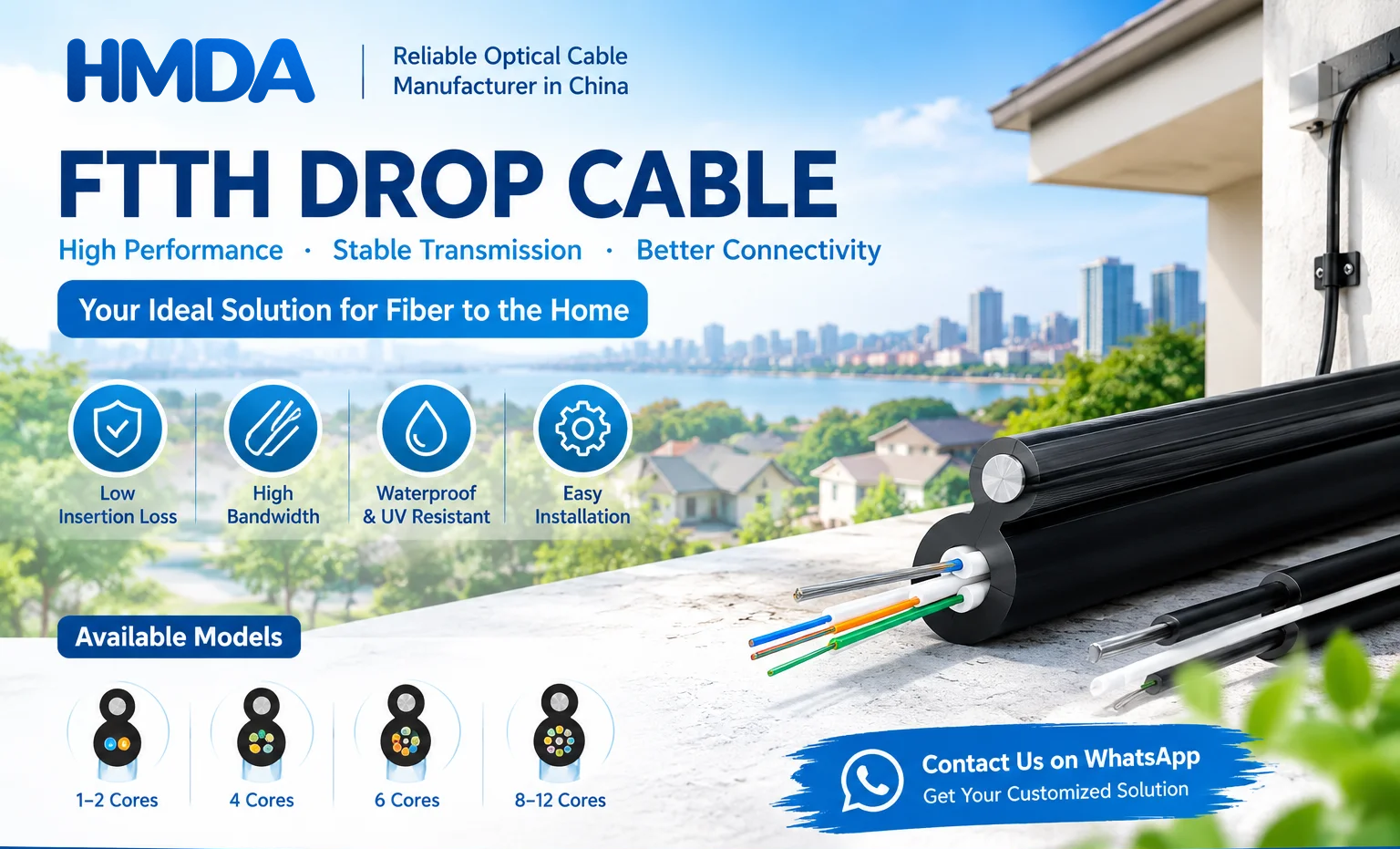
GJXH vs GJYXCH vs GJYXFCH: FTTH Drop Cable Comparison Chart
FTTH Drop Cable Model Numbers at a Glance
Buyers comparing FTTH drop cable usually meet three model numbers: GJXH, GJYXCH and GJYXFCH. All three are flat “butterfly” drop cables built around bend-insensitive G.657A2 fiber, but they are not interchangeable. The difference is the strength member, and the strength member decides where the cable can be installed.
GJXH — indoor butterfly drop cable. A single FRP or steel wire runs inside the flat core. Designed for in-building runs only.
GJYXCH — self-supporting drop cable with a galvanized steel messenger suspended alongside the flat core, for outdoor aerial drops.
GJYXFCH — identical structure to GJYXCH, but the messenger is FRP (non-metallic). Used where lightning, induced voltage or ground potential rise makes a metallic messenger unsafe.
Side-by-Side Specification Comparison
The table below reflects the typical construction Dongguan Hui Hong Fiber Optic Cable Co., Ltd. ships for each model. Values are indicative; the drum label and the test report always govern the delivered product.
| Item | GJXH | GJYXCH | GJYXFCH |
|---|---|---|---|
| Structure | Indoor butterfly | Self-supporting, steel messenger | Self-supporting, FRP messenger |
| Fiber | G.657A2 (G.652D optional) | G.657A2 (G.652D optional) | G.657A2 (G.652D optional) |
| Fiber count | 1–2 (up to 12 on request) | 1–4 | 1–4 |
| Strength member | FRP or steel wire in core | Approx. 1.0 mm galvanized steel messenger | FRP messenger |
| Outer sheath | LSZH or PVC | LSZH indoor / PE outdoor | LSZH indoor / PE outdoor |
| Typical size | Approx. 2.0 × 3.0 mm | Approx. 2.0 × 3.0 mm + messenger | Approx. 2.0 × 3.0 mm + messenger |
| Short-term tension | 100 N | 600 N carried by the messenger | 600 N carried by the messenger |
| Crush resistance | 1000 N/100 mm | 1000 N/100 mm | 1000 N/100 mm |
| Operating temperature | −20 to +60 °C | −40 to +70 °C (PE) | −40 to +70 °C (PE) |
| Typical span | Indoor runs only | Aerial drop up to ~100 m | Aerial drop up to ~100 m |
Which One Should You Buy?
Inside the building, from riser to wall outlet: GJXH with LSZH sheath — low smoke, halogen-free, and no messenger to ground or dress.
Pole-to-house aerial drop in a normal environment: GJYXCH — the steel messenger carries the tension, so the fiber inside sees almost none of it.
Aerial drop where lightning exposure or parallel power lines are a concern: GJYXFCH — all-dielectric, no induced voltage on the messenger and no bonding work.
Quick Answers
Can GJXH be installed outdoors? Only for very short, protected runs. Its PVC/LSZH sheath is not UV-stabilized and it has no messenger, so a real aerial span needs GJYXCH or GJYXFCH.
What is the difference between GJYXCH and GJYXFCH? Only the messenger material: steel (metallic) versus FRP (non-metallic). Mechanical performance is equivalent; the FRP version removes lightning and induction concerns and the need to bond the messenger.
Which fiber is inside? Bend-insensitive G.657A2 as standard — required for the tight bend radii inside FTTH enclosures and wall outlets. G.652D can be supplied on request.
Need a custom fiber count, sheath or logo print? All three models are built to order — see the OEM/ODM process and MOQ explained on the OEM service page, or request a quote.
If you are weighing the flat butterfly drop against the round outdoor drop, the structural comparison in our guide to outdoor FTTH drop cable construction: GJYXCH and GJYXCFCH explained — same fibre count, different jacket and strength member, compared side by side.
Continue reading
Selected references
- ITU-T G-series recommendations — G.652 and G.657 fibre specifications
- IEC Webstore — IEC 60794 optical cable standards