
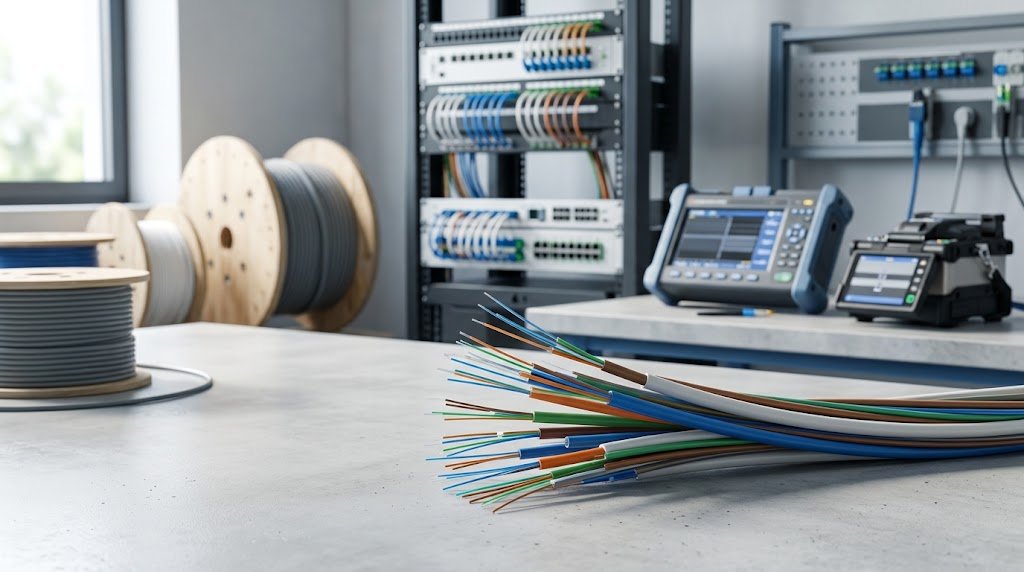
Outdoor FTTH Drop Cable: GJYXCH and GJYXCFCH Last-Mile Guide
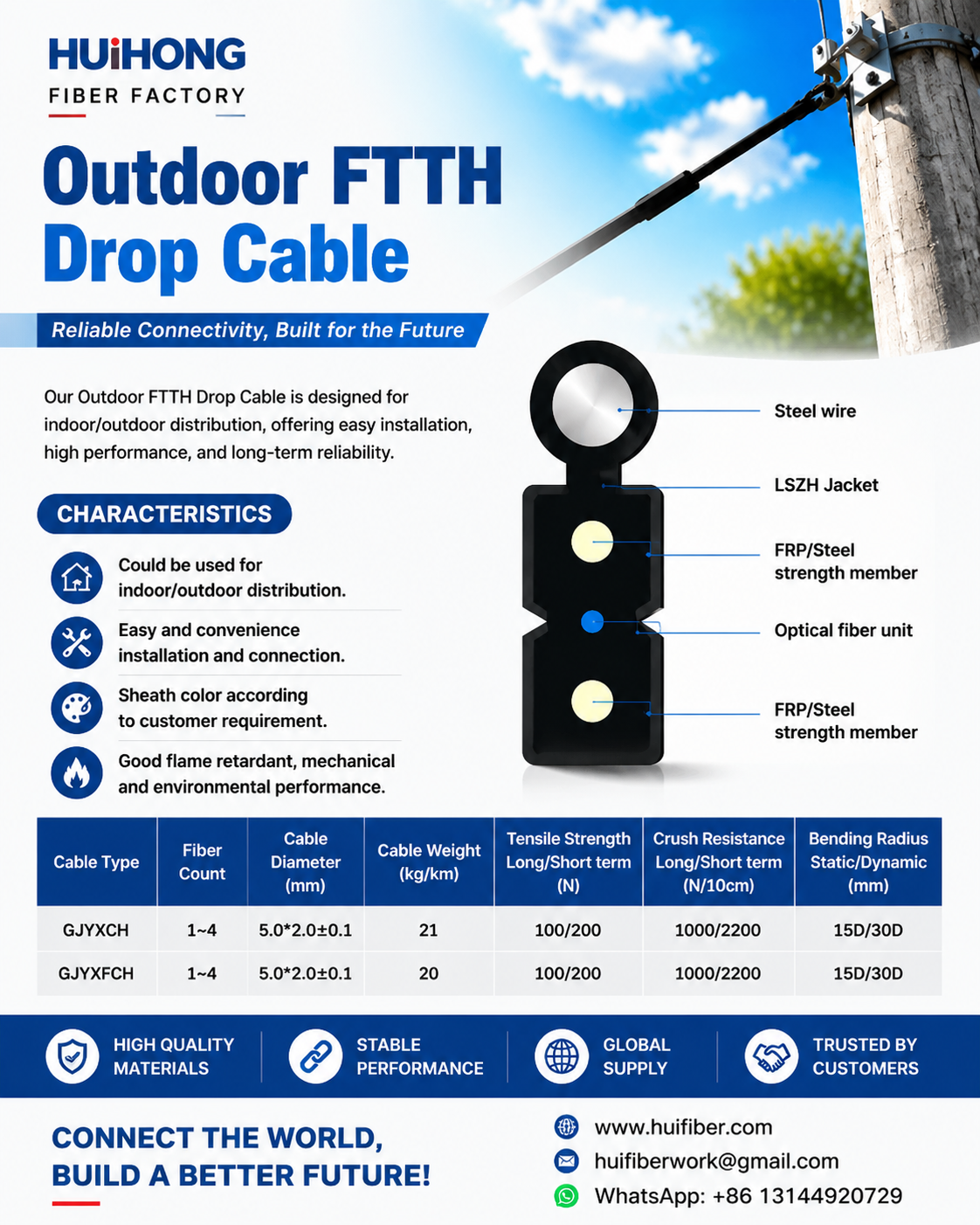
Engineering the Last Mile: Structural Architecture of FTTH Drop Cables
In modern telecommunication networks, the failure rate is disproportionately concentrated in the subscriber drop section. Outdoor FTTH drop cables are specifically designed to bridge this gap by combining optical efficiency with unmatched physical resilience.
Dual FRP/Steel Strength Members: Positioned parallel to the optical fiber unit, these strength members absorb longitudinal tension, preventing fiber micro-bending and attenuation spikes during aerial spans.
Integrated Steel Wire Suspension: For self-supporting aerial installations, an embedded or attached steel wire provides the heavy-duty tensile strength needed to endure wind loads, ice accumulation, and long-term span sagging.
LSZH Outer Sheath: The Low-Smoke Zero-Halogen jacket ensures environmental safety, UV resistance, and excellent flame retardation whether the cable transitions from an outdoor pole to an indoor wall outlet.
Decoding Technical Specifications: GJYXCH vs. GJYXCFCH
Selecting the correct cable variant dictates installation speed and network longevity. Below is a comparative breakdown of standard outdoor
| Cable Type | Fiber Count | Cable Diameter (mm) | Cable Weight (kg/km) | Tensile Strength (Short/Long Term N) | Crush Resistance (N/10cm) | Bending Radius (Static/Dynamic) |
| GJYXCH | 1~4 Core | $5.0 \times 2.0 \pm 0.1$ | 21 | 200 / 100 | 2200 / 1000 | 15D / 30D |
| GJYXCFCH | 1~4 Core | $5.0 \times 2.0 \pm 0.1$ | 20 | 200 / 100 | 2200 / 1000 | 15D / 30D |
vercoming Deployment Challenges in Diverse Environments
Deploying drop cables across mixed rural and urban topographies exposes infrastructure to distinct physical threats.
Aerial Span Management: When stringing cables between poles or building facades, maintaining proper tension control prevents high-wind oscillations from degrading the optical core.
Tight-Corner Indoor Routing: Because FTTH cables often route through narrow conduits, sharp basement corners, and tight indoor spaces, a superior static and dynamic bending radius ($15\text{D}/30\text{D}$) eliminates signal loss caused by sharp turns.
Environmental Adaptability: High crush resistance ($2200\text{ N}/10\text{cm}$) safeguards the optical fiber unit against accidental side impacts, heavy foot traffic, or clamping pressures during termination.
Maximizing Return on Investment through Material Quality
Network operators continuously seek a balance between initial deployment expenditure and ongoing maintenance costs. Utilizing high-grade raw materials—such as precision-extruded LSZH jackets and stable-performance fiber units—drastically reduces truck rolls for troubleshooting broken or degraded drops. By prioritizing robust mechanical parameters and environmental adaptability, operators can future-proof their subscriber base and ensure uninterrupted multi-gigabit delivery.
Continue reading
Selected references
- ITU-T G-series recommendations — G.652 and G.657 fibre specifications