
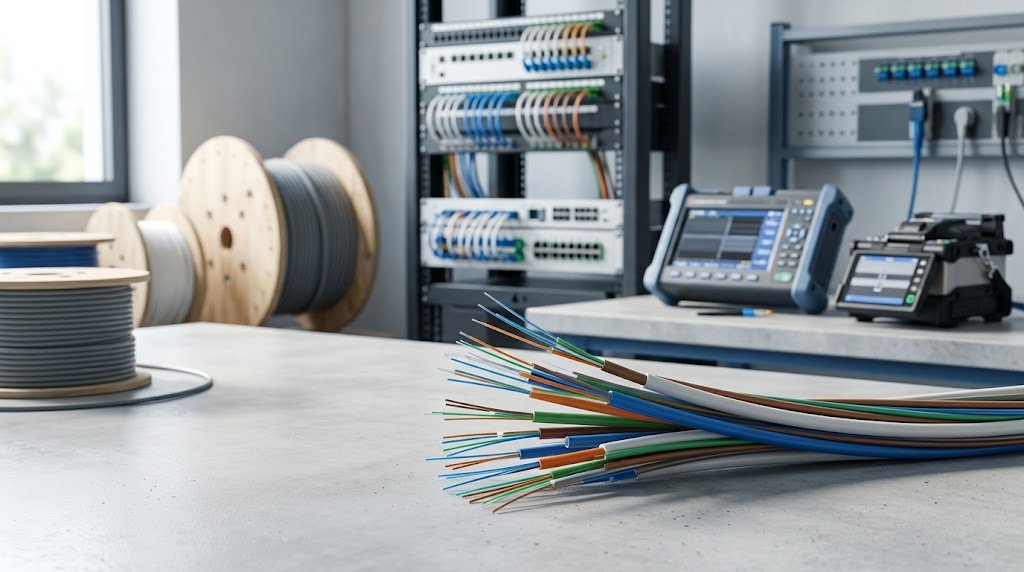
Fiber Optic Cable Manufacturing Capability & Test Reference
This page is the reference we point engineers, buyers and auditors to when they ask “what can the plant actually make, and how is it tested?” Everything below comes from our published datasheets and the factory test regime — not from a brochure.
Plant at a glance
| Item | Value |
|---|---|
| Location | Daojiao Town, Dongguan, Guangdong, China (Pearl River Delta) |
| Floor area | 20,000+ m² |
| Staff | 150+ |
| Legal entity | Dongguan Hui Hong Fiber Optic Cable Co., Ltd. (credit code 91441900MA53KDGU0B) |
| Business type | Manufacturer / factory — OEM and ODM |
| Ports of loading | Shenzhen (Yantian / Shekou) and Guangzhou (Nansha) |
| Product families on this site | 65, across 15 categories |
What the published range actually covers
These ranges are computed from the specification tables on this site, so they describe real, quoted products rather than a theoretical maximum. The smallest item is GJFJH Indoor Single-Mode Breakout Cable with Tight-Buffered Fibres at 4.1 mm; the largest is GYTA33 GYTA333 Armoured Submarine and River Crossing Cable at 20.6 mm.
| Parameter | Published range | Basis |
|---|---|---|
| Cable outer diameter | 4.1 – 21 mm | covers FTTH drop cable through large duct cable |
| Fibre count | 1 – 288 cores | single-core drop cable up to ribbon loose-tube duct cable |
| Allowable tensile force (short term) | 200 – 10,000 N | short-term value per model; the long-term figure is typically one third to one half of it |
| Allowable crush resistance (short term) | 105 – 1,200 N | per IEC 60794-1-2 E3 method; exceeds the 1000 N often specified for duct cable |
| Bending radius | 10D static / 20D dynamic (standard families) | D = cable outer diameter; values differ by model, check each datasheet |
Test regime: routine vs type test
The distinction matters in an audit. Routine tests run on every production length and the result goes on the test report shipped with the drum. Type tests are performed on a representative sample of a design and quoted on the datasheet; they are not repeated per drum.
| Check | When | Method / reference |
|---|---|---|
| Attenuation at 1310 / 1550 nm | Every length (routine) | OTDR bi-directional, IEC 60793-1-40; single-mode limit 0.36 / 0.22 dB/km at 1310 / 1550 nm |
| Attenuation at 850 / 1300 nm | Every multimode length (routine) | IEC 60793-1-40 |
| Length and fibre count verification | Every length (routine) | Drum counter cross-checked against OTDR trace |
| Visual and dimensional inspection | Every length (routine) | Outer diameter, sheath thickness, print legibility |
| Tensile strength | Type test | IEC 60794-1-2 E1 |
| Crush resistance | Type test | IEC 60794-1-2 E3 |
| Repeated bending / torsion / flexing | Type test | IEC 60794-1-2 E6, E7, E8 |
| Temperature cycling | Type test | IEC 60794-1-2 F1, −40 to +70 °C typical for outdoor cable |
| Water penetration | Type test | IEC 60794-1-2 F5B, 1 m head, 24 h |
| Sheath integrity (spark test) | Every length (routine) | In-line DC spark tester on the sheathing line |
What a buyer receives with each shipment: attenuation test report per drum, reel length list, and the applicable type-test report for the design on request. Third-party inspection (SGS, BV, TÜV) can be arranged at the buyer’s cost.
Product families and what each is for
Each row links to the specification table for that family. Use it when you need the model-level numbers rather than the range above.
| Family | Typical models | Where it is used |
|---|---|---|
| Outdoor duct and aerial | GYTS, GYTA, GYTA53, GYXTW, GYFTY | Metro and backbone routes, duct and lashed aerial |
| ADSS aerial | ADSS, GYFTY83, GYFTY86, Mini ASU | Overhead power corridors, no messenger wire needed |
| Aerial figure-8 | GYTC8S, GYXTC8S | Self-supporting aerial drops on existing poles |
| Direct buried | GYTA53, GYTA04, GYFTZY63 | Underground routes, rodent and moisture protection |
| FTTH drop | GJXH, GJYXCH, GJYXFCH, GJYXFCH, hybrid GDXH / GDFJH | Last-mile subscriber connections |
| Indoor and data centre | GJFJH, GJSFJV, OM3 / OM4 breakout | Riser and plenum runs, patch panels, DC trunks |
| Mining and industrial | MGTSV, MGXTSV, MGTS33, GJFZY53(FR) | Flame-retardant routes, shafts, tunnels |
| Sensing and composite | GTSXY, SCTG33Y, GDXTW, GDVV | DTS monitoring, 5G RRU hybrid feed |
| Passive and accessories | PLC splitter, ODF, patch panel, adapters | Distribution and termination |
Standards we quote against
Datasheets on this site reference the following. If your tender cites a different edition, tell us and we will state compliance explicitly rather than assume it.
- IEC 60793-1-40 — attenuation measurement
- IEC 60794-1-1 / -1-2 — optical cable generic specification and test methods
- IEC 60794-3 — outdoor cables
- IEC 60794-4 — aerial optical cables along electrical power lines (ADSS)
- IEEE Std 1222 — All-Dielectric Self-Supporting fibre optic cable
- ITU-T G.652.D — single-mode fibre, low water peak
- ITU-T G.657.A1 / A2 — bend-insensitive single-mode fibre
- YD/T 769 — China industry standard for outdoor optical cable
What we are not
Stating this plainly saves both sides time:
- We are a cable assembler, not a fibre drawer. Fibre is bought from tier-1 suppliers and comes with the supplier’s own attenuation certificate.
- We do not publish an ISO certificate number. Our management systems are established and operated to ISO standards; the certificate held by our parent company expired on 10 December 2023 and is therefore not quoted.
- We do not claim a monthly output figure. Capacity depends on the mix of models and is quoted per order after the specification is fixed.
Request the details
Send the route, fibre count and environment and we will come back with a model, a test plan and a lead time. Typical lead time is 7–15 days for standard models after drawing approval.
Continue reading
- Fiber Optic Cable Manufacturing Capability & Test Reference
- What are the three main advantages of ribbon optical fiber patch cords?
- Meet Huifiber at CIOE 2026 Shenzhen: Innovative Optical Fiber Cable Solutions
- Optical Fiber Cable Standards Explained: IEC 60794, ITU-T G.652D and G.657
- Fiber Optic Cable vs Copper Cable: Which Should You Choose?
Selected references
- IEC Webstore — IEC 60794 optical cable standards
- ITU-T G-series recommendations — G.652 and G.657 fibre specifications