
Mini ASU Fiber Cable Selection: Core Count, Span and Jacket
ASU Mini Fiber Optic Cable: Selection, Construction, Applications and Custom Design Considerations
ASU Mini fiber optic cable is increasingly used in aerial access networks where compact dimensions, controlled weight and reliable outdoor performance are important.
However, choosing an ASU Mini cable should not begin with the question of which standard model is available.
The more important question is:
What cable structure is appropriate for the network, installation environment and future expansion requirements?
A 12-core ASU Mini cable, for example, may look similar across different manufacturers, while its outer diameter, weight, strength member, fiber configuration, sheath design and installation characteristics can be different.
For this reason, ASU Mini selection is better approached as an engineering decision rather than simply a product-model decision.
1. What Is ASU Mini Fiber Optic Cable?
ASU Mini is a compact aerial fiber optic cable designed for outdoor communication networks.
Its design focuses on balancing several requirements:
Compact cable dimensions
Controlled cable weight
Suitable mechanical strength
Outdoor environmental resistance
Efficient aerial installation
Practical fiber capacity
The exact construction can vary according to fiber count, installation conditions and project specifications.
This flexibility makes ASU Mini suitable for different types of access and distribution networks rather than being limited to a single application.
2. How to Select the Right ASU Mini Cable
Fiber count is only the starting point.
A more complete selection should consider the entire installation environment.
Fiber Count
Common configurations may include:
2 fibers
4 fibers
6 fibers
8 fibers
12 fibers
24 fibers
The appropriate fiber count depends on the current network architecture and the amount of fiber capacity that may be required later.
A small access connection may require only a few fibers, while a distribution route connecting several network points may benefit from additional spare capacity.
Selecting the lowest fiber count is not always the most efficient long-term solution.
Fiber Type
The optical fiber itself should match the transmission system and network requirements.
Important considerations may include:
Fiber category
Operating wavelength
Attenuation requirements
Transmission distance
Equipment compatibility
Environmental conditions
For a project with clearly defined technical requirements, the fiber specification should be confirmed before the cable structure is finalized.
Cable Diameter and Weight
The dimensions and weight of an aerial cable affect installation, handling and supporting hardware.
A compact cable can simplify transportation and installation, but reducing the dimensions should not compromise the mechanical requirements of the application.
The objective is not simply to make the cable smaller.
The objective is to create a balanced cable structure for the intended installation conditions.
Mechanical Requirements
Aerial cables are exposed to mechanical forces during installation and throughout their service life.
Depending on the project, the cable design may need to account for:
Tensile load
Installation conditions
Span length
Wind exposure
Temperature variation
Supporting hardware
Long-term environmental loading
This is one reason why two cables with the same fiber count may have completely different structural designs.
3. Understanding the Construction of ASU Mini
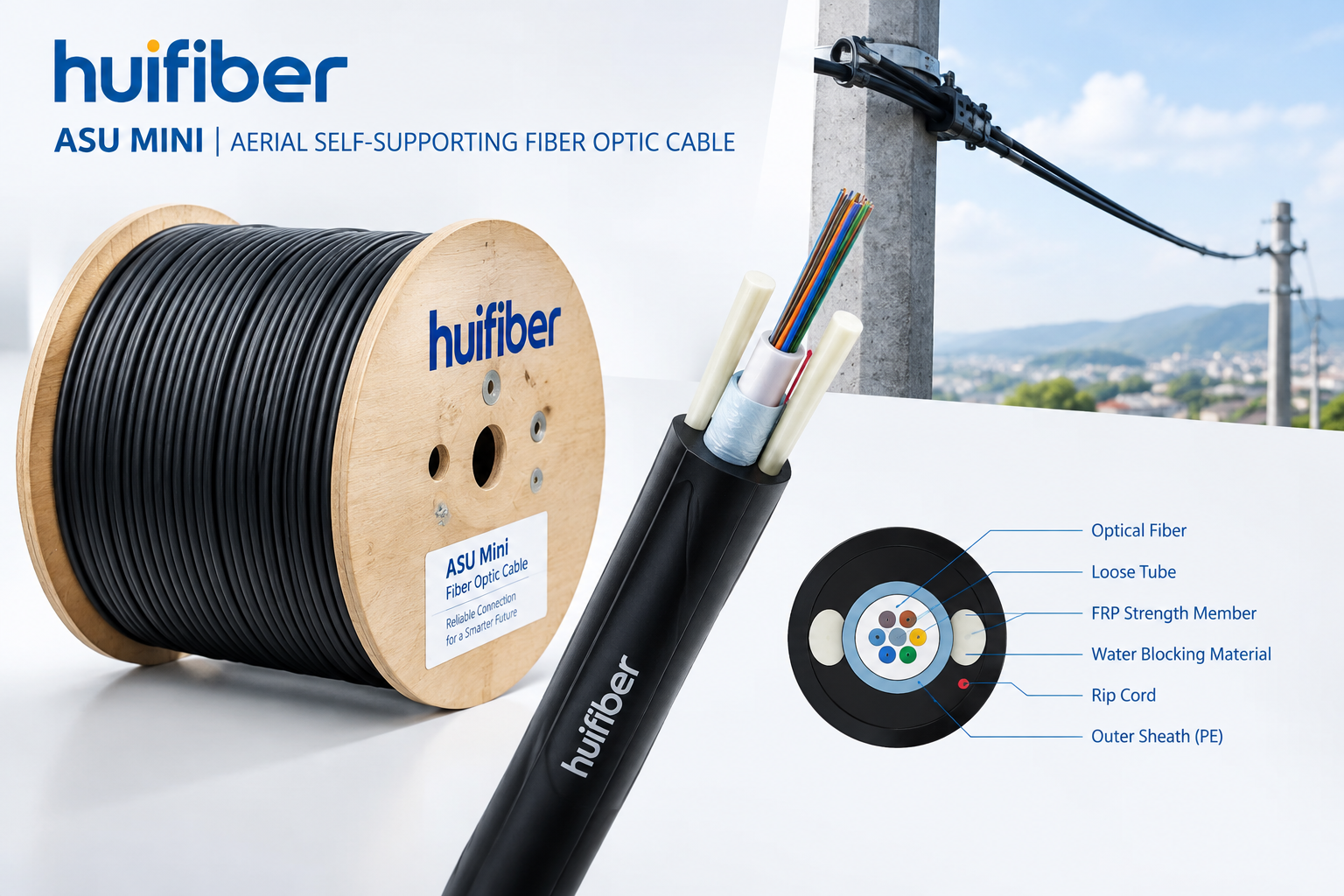
The performance of an ASU Mini cable comes from the interaction between its different structural components.
Optical Fiber
The optical fiber provides the transmission path for data and communications.
Fiber selection should be based on the network architecture rather than simply choosing the most commonly used specification.
Loose Tube
The optical fibers are generally protected within a loose-tube structure.
The loose tube provides space around the fibers and helps protect them against mechanical and environmental influences.
Tube dimensions, materials and internal design can affect the overall cable structure.
Strength Member
The strength member contributes to the mechanical performance of the cable.
Its design should correspond to the intended installation conditions rather than being selected independently from the rest of the cable.
The appropriate strength configuration depends on factors such as:
Cable size
Fiber count
Span requirements
Installation method
Environmental loading
Outer Sheath
The outer sheath is the cable’s primary external protection.
For outdoor applications, sheath selection should take into account environmental exposure such as:
UV radiation
Rain
Humidity
Temperature changes
Outdoor aging
Local installation conditions
The correct sheath design is therefore closely related to the country, climate and network environment in which the cable will be installed.
4. Why Fiber Count Does Not Tell the Whole Story
Two ASU Mini cables can both be labeled as 12-core products and still behave differently in a real project.
The differences may come from:
| Design Factor | Potential Project Impact |
|---|---|
| Fiber specification | Transmission compatibility |
| Fiber count | Network capacity |
| Cable diameter | Installation and hardware compatibility |
| Cable weight | Handling and aerial installation |
| Strength member | Mechanical performance |
| Sheath material | Outdoor durability |
| Span requirement | Structural design |
| Drum length | Transportation and deployment |
| Cable identification | Installation and maintenance |
This is why technical specifications should be considered as a complete set rather than as individual numbers.
5. Where Is ASU Mini Used?
FTTH Access Networks
ASU Mini can be used in aerial sections of fiber-to-the-home networks where compact cable construction and practical installation are important.
It can support the connection between distribution points and local access areas.
Rural Broadband Networks
Rural networks often involve long routes, dispersed users and challenging installation environments.
A compact aerial cable can provide a practical option where underground construction is difficult or costly.
ISP Access and Distribution Networks
Internet service providers may expand their networks gradually.
In such environments, cable selection should consider both current requirements and potential future expansion.
A suitable fiber count and structural configuration can provide additional flexibility as the network develops.
Suburban and Regional Communication Networks
ASU Mini can also be considered for suburban and regional aerial communication routes where a compact outdoor fiber cable is appropriate for the network architecture.
CCTV and Dedicated Communication Networks
Certain surveillance, industrial and private communication networks also require outdoor fiber connections.
For these applications, the most important selection criteria may be distance, fiber count, installation conditions and environmental resistance rather than maximum fiber capacity.
6. ASU Mini for Different Installation Environments
There is no single ASU Mini structure that is automatically ideal for every project.
A cable designed for a short urban access route may not be the most appropriate configuration for a long rural aerial route.
Project conditions can include:
Short Aerial Routes
The design may prioritize compact dimensions, easy handling and efficient installation.
Longer Spans
Mechanical requirements become more important, particularly where the cable is exposed to greater environmental loading.
High-Exposure Areas
Projects exposed to strong sunlight, high humidity, frequent rain or significant temperature changes may require different sheath and material considerations.
Dense Distribution Networks
Fiber count and future expansion become increasingly important where multiple network branches are connected along the route.
The cable should therefore be selected according to the actual environment instead of simply copying a standard catalog specification.
7. Why Customization Matters in ASU Mini Cable Design
Customization does not necessarily mean creating an entirely new cable.
In many projects, customization means adjusting selected characteristics to achieve a better match between the cable and the installation environment.
Possible design parameters may include:
Fiber count
Fiber type
Loose-tube configuration
Strength member
Outer diameter
Cable weight
Sheath material
Sheath color
Printing requirements
Drum length
Packaging configuration
The purpose is to create a cable that fits the project’s technical requirements rather than forcing the project to fit a standard product.
8. Huifiber’s Approach: Design Around the Application
At Dongguan Hui Hong Fiber Optic Cable Co., Ltd., ASU Mini is approached as a configurable fiber optic cable product rather than a single fixed specification.
The starting point is the application.
Instead of asking only:
“Which ASU Mini model do we have?”
the design process can begin with:
“What does the network require?”
This difference allows the cable structure to be considered together with the installation environment, fiber capacity and mechanical requirements.
Application-Based Configuration
Different projects can require different combinations of:
Fiber capacity
Cable dimensions
Mechanical strength
Environmental protection
Installation requirements
Packaging specifications
Huifiber’s manufacturing approach allows these factors to be considered together when developing a project-specific cable configuration.
OEM and Private-Label Manufacturing
For customers with their own product specifications, brands or distribution systems, ASU Mini can be manufactured according to agreed technical requirements.
This can include:
Cable identification
Sheath printing
Product structure
Fiber configuration
Packaging
Drum requirements
The objective is consistency between the finished cable and the customer’s existing product system.
9. From Standard Product to Project-Specific Cable
A common mistake in cable selection is to compare products only by their catalog names.
A more meaningful comparison is based on the complete technical profile.
For example:
12-core ASU Mini
is only a product description.
A more useful engineering description would include:
12 fibers + fiber specification + structural design + outer diameter + weight + mechanical requirements + sheath specification + installation environment
This is where product customization becomes meaningful.
The same nominal fiber count can be engineered into different cable configurations depending on the project.
10. What Should Be Confirmed Before Selecting ASU Mini?
Before finalizing an ASU Mini cable design, it is useful to establish several basic project parameters:
Required fiber count
Fiber type
Typical installation environment
Approximate span conditions
Required cable length per drum
Outdoor environmental conditions
Installation method
Supporting hardware requirements
Future network expansion plans
Customer-specific identification or packaging requirements
Having these parameters available makes the product selection process more precise and reduces unnecessary changes later in the project.
11. ASU Mini Is About Balance, Not Simply Size
The word “Mini” can easily create the impression that the smallest cable is automatically the best choice.
In practice, cable design is about balance.
A suitable ASU Mini configuration should find the right relationship between:
Optical performance
Mechanical strength
Cable dimensions
Weight
Environmental resistance
Installation efficiency
Network capacity
Reducing one parameter without considering the others can create problems elsewhere in the system.
The goal is therefore not simply to produce a smaller cable.
The goal is to produce a compact cable with the right structure for its intended application.
12. Why Huifiber for ASU Mini Customization?
Dongguan Hui Hong Fiber Optic Cable Co., Ltd. focuses on fiber optic cable manufacturing and project-oriented product development.
Our approach is based on three principles:
Application First
The cable configuration should be connected to the actual network environment.
Structure Matters
Fiber count alone cannot define the performance of an aerial cable. The complete structure needs to be considered.
Consistency Matters
For B2B projects, stable production and consistent specifications are as important as the initial product design.
This approach allows Huifiber to support customers who need more than a standard catalog product.
From fiber configuration and cable structure to sheath requirements and packaging, the product can be developed around the application.
Conclusion
ASU Mini fiber optic cable is not simply a smaller version of a conventional aerial cable.
Its value comes from finding the right balance between fiber capacity, cable structure, mechanical performance, environmental protection and installation requirements.
For network operators, contractors and fiber optic distributors, the most suitable ASU Mini configuration depends on the actual project rather than on fiber count alone.
At Huifiber, we believe that a better cable starts with a better understanding of the application.
The right fiber count.
The right structure.
The right materials.
The right configuration for the network.
That is the difference between selecting an ASU Mini cable and designing an ASU Mini cable for a real project.
Continue reading
Selected references
- ITU-T G-series recommendations — G.652 and G.657 fibre specifications
- IEEE Standards — IEEE 1222 for ADSS cable