
Fiber Optic Cable Types Explained: Buyer Guide with Chart
Why Cable Type Decides Your Network Cost
Choosing the right fiber optic cable type at design stage is the single largest lever on both material cost and long-term failure rate. A cable specified for aerial self-supporting duty installed in a duct wastes money; a duct cable strung between poles will fail within a season.
Classification by Installation Environment
| Environment | Common models | Typical use |
|---|---|---|
| Duct | GYTA, GYTS, GYFTY, GYFXTY | Metro, access, backbone |
| Direct buried | GYTA53, GYTY53 | Long rural spans without duct |
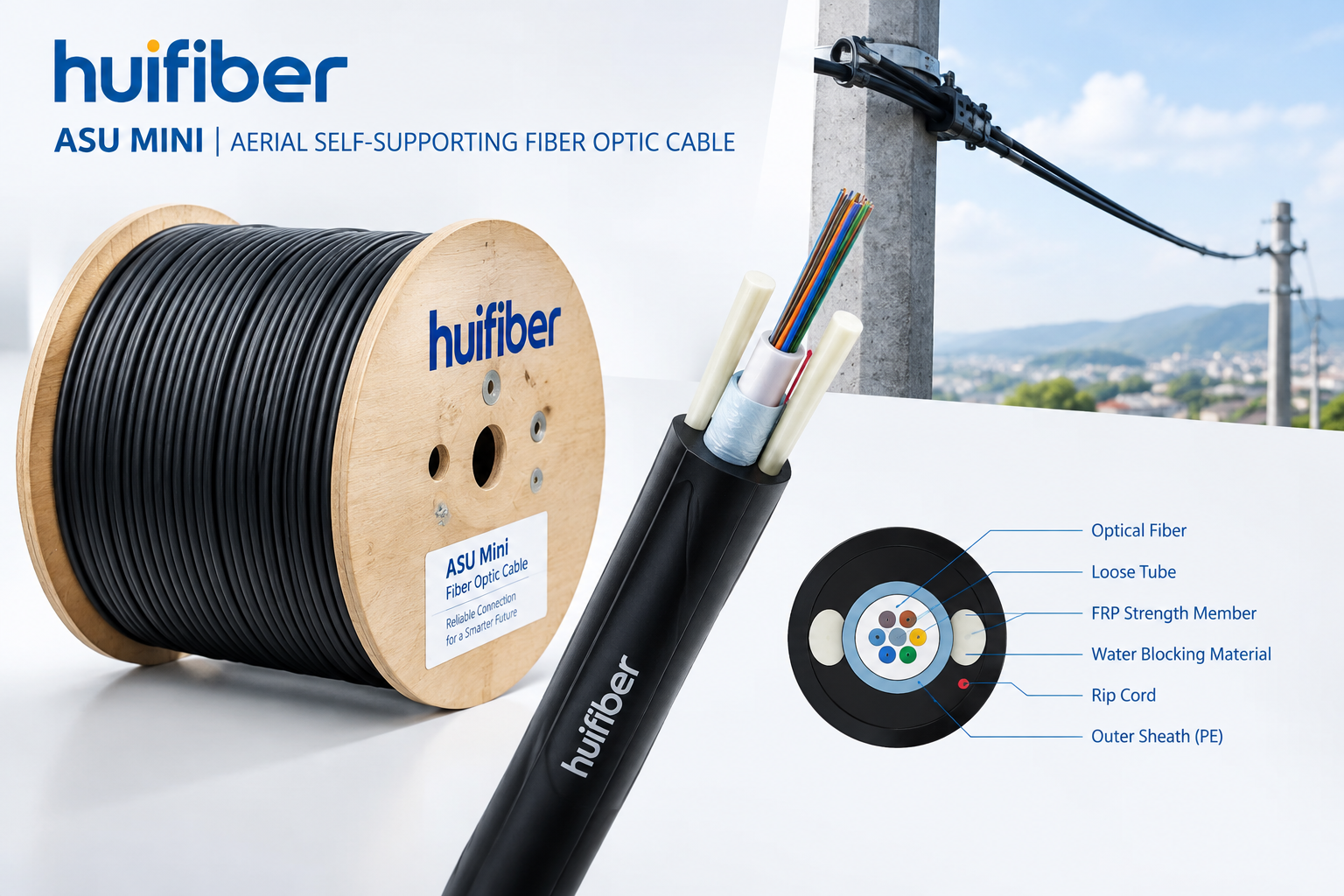
| Aerial self-supporting | ADSS, GYTC8S, Figure-8 | Pole routes, power corridors |
| Indoor / riser | GJFJH, GJSFJV, LSZH distribution | In-building cabling, data centres |
| FTTH last mile | GJXH, GJXCH, GJYXCH, flat / round drop | Subscriber drop |
| Special / sensing | Composite, armoured, DTS sensing cable | Mining, military, monitoring |
Outdoor Fiber Optic Cable Types
- Duct cable (GYTA, GYTS, GYFTY). The workhorse of metro and access networks. Stranded loose tube construction, steel or FRP strength member, water-blocking fill. GYTS adds a corrugated steel tape for rodent and crush protection.
- Direct buried cable (GYTA53, GYTY53). Double sheath with an armour layer, designed for trench installation without ducts.
- Aerial self-supporting cable (ADSS, Figure-8, GYTC8S). All-dielectric or metallic messenger constructions for pole routes. ADSS is preferred near power lines because it is immune to electromagnetic interference.
- Non-metallic cable (GYFXTY, GYFTY). Fully dielectric, ideal for lightning-prone and high-induction routes.
Indoor and Riser Cable Types
- Tight-buffered distribution and breakout cable (GJFJH, GJSFJV). 0.9 mm buffered fibers for patch-panel termination inside buildings.
- LSZH indoor cable. Low-smoke zero-halogen jacket for data centres, hospitals and tunnels where fire safety is mandatory. Riser-rated and plenum-rated variants differ in flame spread rating.
FTTH Drop Cable Types
Drop cables connect the access network to the subscriber. The most common are bow-type (butterfly) drop cables GJXH, GJXCH and self-supporting GJYXCH; flat drop cable; and round drop cable. Bend-insensitive G.657 fiber allows tight bends around building corners without added loss.
Special and Sensing Cable Types
For mining, military, high-temperature and DTS/DAS sensing applications, composite and armoured constructions add steel tubes, flame-retardant jackets and distributed sensing fibers.
Accessories That Complete the Link
Cable types only cover the span. A working link also needs patch cords, pigtails, PLC splitters, ODF frames, splice closures, adapters and terminal boxes. Huifiber supplies all of them so the whole bill of materials comes from one qualified source.
If you are not sure which construction suits your route, send us the installation environment, span and core count. Our engineers will recommend a specific model and supply the corresponding datasheet so you can compare options side by side.
Continue reading
Selected references
- ITU-T G-series recommendations — G.652 and G.657 fibre specifications
- IEC Webstore — IEC 60794 optical cable standards